




-

"Very nice Posters. The quality is amazing and we received it very quickly !"
-

"A shop to visit absolutely. Huge selection of posters. We spent more than an hour there !"
-

"Perfect to find gift. Price are very good. An they can frame and pack it on site"


About the Artist
Pieter Cornelis Mondriaan was a Dutch painter and a pivotal figure in the De Stijl movement, which emerged in the early twentieth century. His artistic journey led him from the Netherlands to Paris, where he gradually developed his signature style of pure abstraction, using only straight lines and primary colors. Mondriaan sought to express universal harmony through his art, influencing generations of artists, designers, and architects.
His legacy endures as a cornerstone for those interested in famous artists and for admirers of modernist innovation in visual culture.
The Artwork
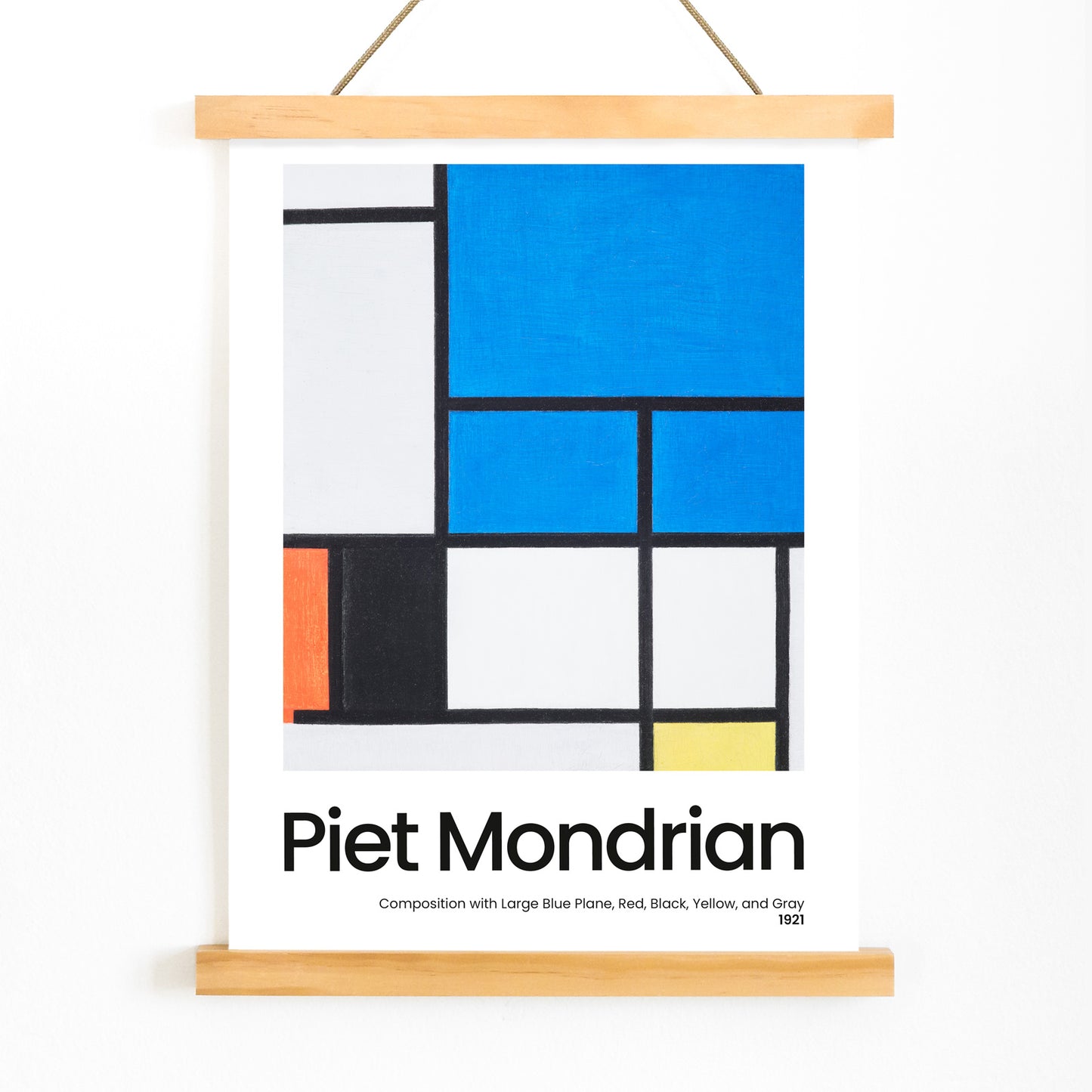
Painted in 1921, Composition with Large Blue Plane reflects Mondriaan's quest for balance and order in the aftermath of World War I. Rather than representing recognizable subjects, the work embodies his belief in art as a means to achieve spiritual and social renewal. Mondriaan's compositions from this period became visual manifestos for the ideals of De Stijl, advocating clarity and unity in a rapidly changing world.
This piece, with its interplay of form and color, became influential far beyond painting, shaping developments in design, architecture, and interior aesthetics. As a 1921 Mondriaan composition, it remains a touchstone for those drawn to the language of modern abstraction and its impact on contemporary spaces.
Style & Characteristics
The artwork is defined by a precise grid of vertical and horizontal black lines, dividing the canvas into rectangles and squares. A dominant blue rectangle anchors the composition, complemented by smaller blocks of red and yellow, with ample white space providing balance. The use of flat, unmodulated color and sharp edges creates a sense of clarity and order, while the asymmetrical arrangement adds visual tension and energy.
This approach places the work firmly within the realm of abstract art and makes it especially appealing to those who appreciate blue accents and geometric precision in their collections.
In Interior Design
This art print enhances modern interiors, from living rooms and offices to creative studios, where structure and subtle vibrancy are valued. Its strong geometry pairs well with minimalist or mid-century furnishings, as well as Bauhaus-inspired decor, offering a focal point without overwhelming the space.
To echo the artwork's aesthetic, consider incorporating black or chrome details and touches of primary color in accessories. The print is particularly striking in a white setting, and a simple frame from the frames collection can complete the look with understated elegance.