


You may also like
-
Color Patchwork Poster
Otto Freundlich · 1936 · Vibrant abstract poster of interlocking color tiles unified by bold black outlines
Poster from CHF 9 · Framed from CHF 16
Regular price From CHF 6.00Regular price -
Komposition Poster
Otto Freundlich · 1936 · Vibrant geometric art print with interlocking color planes and bold modernist energy
Poster from CHF 9 · Framed from CHF 16
Regular price From CHF 6.00Regular price -
Composition Poster
Georges Valmier · 1921 · Dynamic abstract art print of interlocking shapes and vivid color blocks in motion
Poster from CHF 9 · Framed from CHF 16
Regular price From CHF 6.00Regular price -
Composition Abstraite Poster
Otto Freundlich · 1937 · Vibrant geometric art print of interlocking color blocks outlined in black
Poster from CHF 9 · Framed from CHF 16
Regular price From CHF 6.00Regular price


-

"Very nice Posters. The quality is amazing and we received it very quickly !"
-

"A shop to visit absolutely. Huge selection of posters. We spent more than an hour there !"
-

"Perfect to find gift. Price are very good. An they can frame and pack it on site"


About the Artist
Joseph Schillinger was a composer, theorist, and educator whose innovative ideas bridged music, mathematics, and visual art. Active in the United States during the interwar period, Schillinger developed systematic approaches to rhythm and form that resonated with a generation of modern artists and designers.
His interdisciplinary outlook is evident in works like this, where visual structure echoes musical composition. For more geometric inspiration, see our abstract posters and music themed prints.
The Artwork
Created in 1934, Area Broken by Perpendiculars reflects a time when artists sought to express the dynamism of modern life through geometry and order. Influenced by movements such as Constructivism and the Bauhaus, Schillinger approached the picture plane as a field to be organized and explored mathematically, rather than depicted representationally.
This work is a conceptual study in structure: it explores how the division of space by perpendicular lines can create visual rhythm, tension, and harmony. The composition invites viewers to experience geometry as an active, almost musical process, rather than a static arrangement.
Style & Characteristics
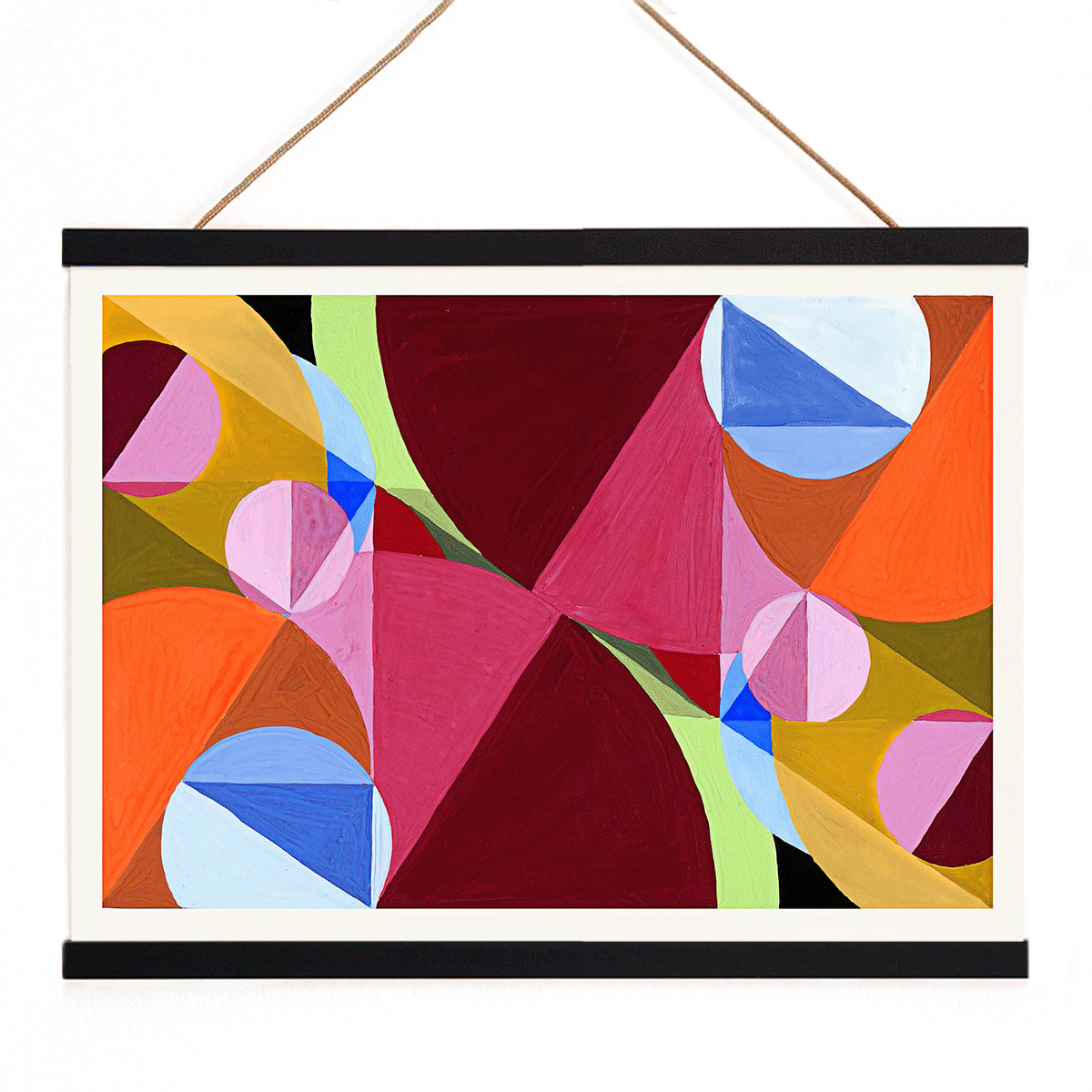
The print features a precise grid of perpendicular lines that fragment the surface into asymmetric blocks and bands. Bold reds, oranges, pinks, blues, and yellows are juxtaposed with deep black lines, producing striking contrasts and a sense of movement across the composition.
The overall effect is crisp and intentional, with a graphic clarity reminiscent of modernist poster design. The mood is both analytical and vibrant, balancing rigorous construction with energetic bursts of color.
In Interior Design
This geometric art print is well suited to contemporary living rooms, studios, or workspaces that favor clean lines and dynamic forms. It complements mid-century modern furnishings, minimalist décor, and interiors that highlight bold shapes and open space.
To integrate the palette, consider echoing one of the print’s vivid hues in accent pieces like cushions or ceramics, while keeping the surrounding area neutral. For those interested in design history, it pairs beautifully with Bauhaus inspired wall art and can serve as a striking anchor in a curated gallery wall.