


You may also like
-

The Ten Largest No. 8 Poster
Hilma af Klint · 1907 · Ethereal abstract art print of spirals and symbolic forms in pink, yellow, and blue
Poster from CHF 9 · Framed from CHF 16
-

The Ten Largest, Childhood, No 2 Poster
Hilma af Klint · 1907 · Luminous abstract art print with swirling forms in blue, pink, orange, and yellow
Poster from CHF 9 · Framed from CHF 16
-

The Ten Largest, No. 6 Poster
Hilma af Klint · 1907 · Radiant abstract poster of swirling forms and symbols in soft pinks and purples
Poster from CHF 9 · Framed from CHF 16
-

The Ten Largest No 7 Poster
Hilma af Klint · 1907 · Radiant abstract art print with swirling biomorphic forms on a sunlit yellow field
Poster from CHF 9 · Framed from CHF 16


-

"Very nice Posters. The quality is amazing and we received it very quickly !"
-

"A shop to visit absolutely. Huge selection of posters. We spent more than an hour there !"
-

"Perfect to find gift. Price are very good. An they can frame and pack it on site"


About the Artist
Hilma af Klint was a Swedish painter whose pioneering abstract works predated many of her contemporaries in the early twentieth century. Trained at the Royal Academy in Stockholm, she combined precise draftsmanship with a deep interest in spiritualism, theosophy, and the exploration of invisible realities. Her art was shaped by group séances and a belief in art as a means of communicating higher truths.
Af Klint’s major cycles, including The Ten Largest, were created in private and intended for a future audience receptive to new ideas about consciousness and form. Today, her legacy is central to the story of modern abstraction, and her work is celebrated among famous artists posters for its visionary approach and historical significance.
The Artwork
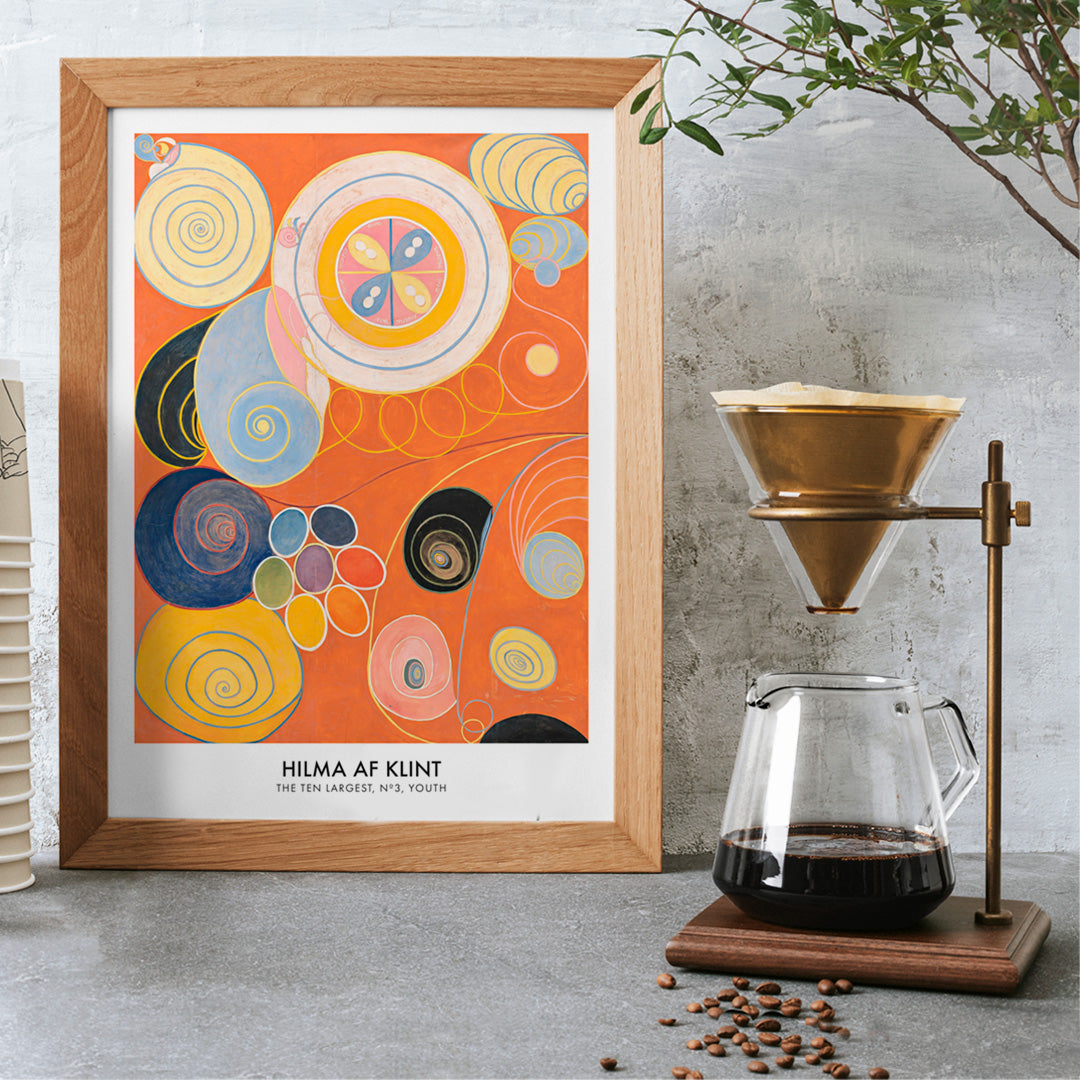
The Ten Largest No. 3 is part of the Youth section within af Klint’s monumental series, which explores the human life cycle through symbolic abstraction. Rather than depicting literal scenes, af Klint sought to express the spiritual and psychological qualities associated with youth—growth, vitality, and transformation—through color and form.
Conceived as part of a larger spiritual project, these paintings were not publicly exhibited during her lifetime. Af Klint envisioned them as meditative works to be experienced in a contemplative setting, reflecting her belief in art’s power to guide viewers toward deeper understanding. This piece resonates with those interested in early modern symbolism and esoteric wall art.
Style & Characteristics
The composition features a luminous orange background filled with floating ovals, spirals, petal-like shapes, and looping lines. Accents of blue, yellow, and black punctuate the surface, while the overlapping forms create a rhythmic sense of movement and energy. There is no single focal point; instead, the eye is invited to wander across the layered, dynamic elements.
Af Klint’s use of tempera yields matte, velvety color fields and crisp edges, while her biomorphic motifs evoke both diagrams and playful organic forms. The overall mood is vibrant yet contemplative, making this abstract art print a striking addition to a collection of abstract posters.
In Interior Design
This poster introduces warmth and flow to living rooms, studios, or hallways, serving as an energetic focal point without overwhelming the space. The orange base harmonizes with natural woods, off-white walls, and black accents, while the blue and yellow details complement ceramics and textiles.
It fits seamlessly into modern, Scandinavian, or eclectic interiors, especially where clean lines are paired with expressive art. A simple frame allows the artwork’s swirling forms to stand out, making it an ideal statement piece for admirers of early abstract painting.