


You may also like
-
Two lilies Poster
Anton Weiss · 2006 · Monochrome lily botanical print with two blossoms and elegant stems on warm beige
Poster from CHF 9 · Framed from CHF 16
Regular price From CHF 6.00Regular price -
Marigold Poster
Pierre François Legrand · 2014 · Delicate black and white marigold botanical print with crisp linework and airy negative space
Poster from CHF 9 · Framed from CHF 16
Regular price From CHF 6.00Regular price -
Rose de Provins Poster
Jean Benjamin Godefroy · 1819 · Refined rose botanical print with precise engraving lines and airy natural history spacing
Poster from CHF 9 · Framed from CHF 16
Regular price From CHF 6.00Regular price -
Hundred-petaled rose Poster
Pierre François Legrand · 1782 · Delicate rose botanical print with fine line shading and a quiet naturalist presence
Poster from CHF 9 · Framed from CHF 16
Regular price From CHF 6.00Regular price


-

"Very nice Posters. The quality is amazing and we received it very quickly !"
-

"A shop to visit absolutely. Huge selection of posters. We spent more than an hour there !"
-

"Perfect to find gift. Price are very good. An they can frame and pack it on site"


About the Artist
Louis Charles Ruotte was an early nineteenth-century engraver renowned for his botanical plates, which were commissioned for scientific books and portfolios. Working during a period when botanical science was flourishing, Ruotte played a key role in making plant knowledge accessible to a broader European audience through precise, reproducible images.
His engravings are part of the tradition of scientific illustration, where clarity and accuracy were paramount. Today, Ruotte’s work is valued for its refined approach to vintage botanical art, bridging the worlds of natural history and classic decorative aesthetics.
The Artwork
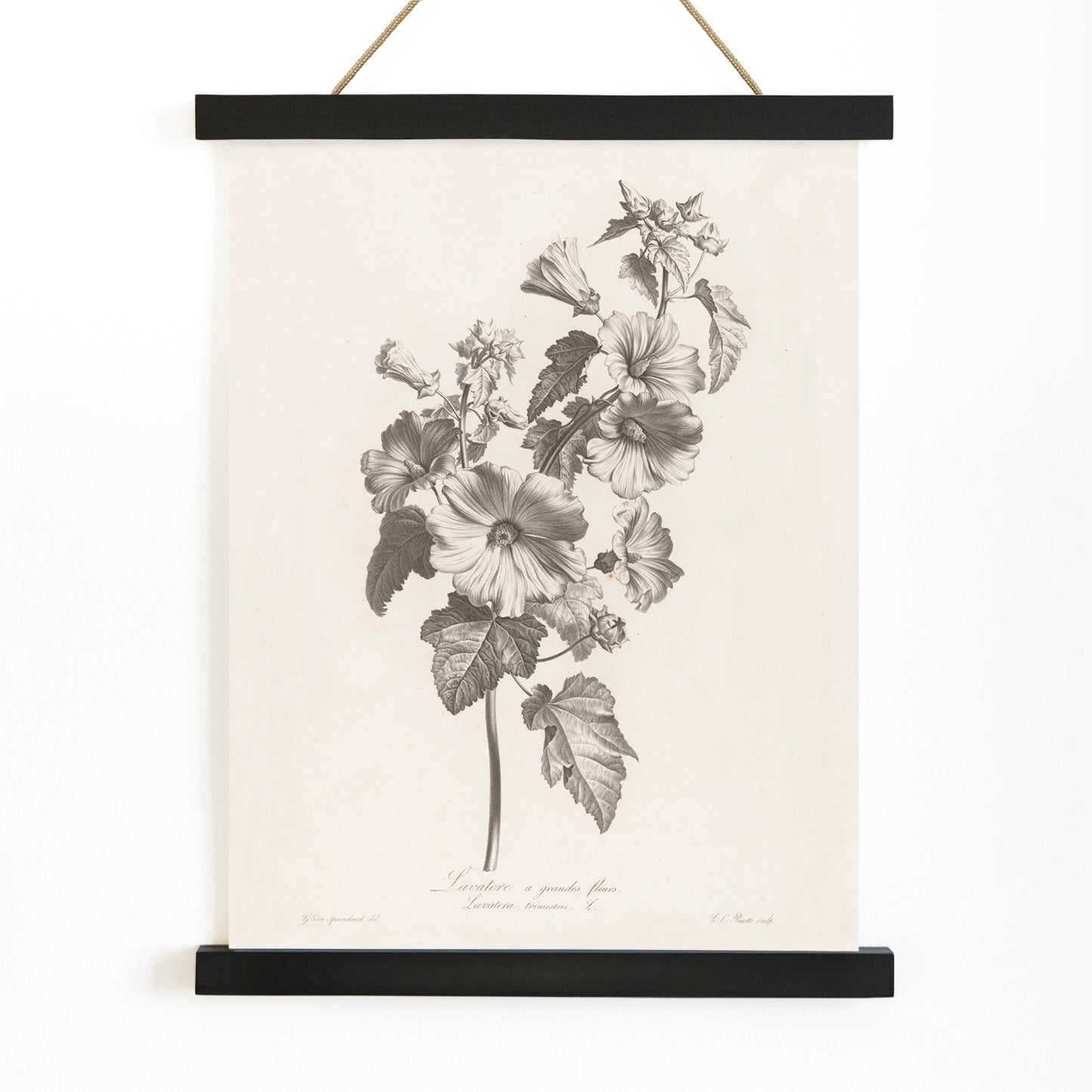
This plate depicting Lavatera was created at a time when botanical illustration was essential for plant identification and education. In the early 1800s, such images supported the spread of horticultural knowledge and reflected the era’s fascination with cataloguing nature.
Botanical plates like this one often accompanied scholarly texts, serving as visual references for botanists, gardeners, and collectors. The Lavatera illustration embodies the intersection of scientific inquiry and the appreciation of garden beauty that characterized the period.
Style & Characteristics
The artwork features a single Lavatera plant, rendered with meticulous engraved linework that highlights the structure of stems, leaves, and blossoms. The composition is clear and instructional, typical of early nineteenth-century botanical illustration.
The palette is restrained, using soft grey tones and ample white space to create a calm, airy effect. The monochrome approach lends the print a scholarly, archival quality, making it both elegant and understated for contemporary interiors.
In Interior Design
This botanical print complements interiors with light neutrals and subtle textures, from minimalist modern rooms to traditional spaces with vintage influences. It pairs harmoniously with white toned wall decor and materials like linen, stone, or pale wood.
For a cohesive display, combine it with other botanical prints or integrate it into a classic art gallery wall. Its gentle presence suits bedrooms, hallways, kitchen nooks, or quiet home offices seeking a touch of natural history.