


You may also like
-
Attalea Compta 2 Poster
Carl Friedrich Philipp von Martius · 1823 · Detailed palm botanical print with scientific studies on warm beige paper
Poster from CHF 9 · Framed from CHF 16
Regular price From CHF 6.00Regular price -
Astrocaryum Vulgare Poster
Carl Friedrich Philipp von Martius · 1823 · Detailed palm botanical print with specimen studies on warm beige paper
Poster from CHF 9 · Framed from CHF 16
Regular price From CHF 6.00Regular price -
Euterpe Oleracea Poster
Carl Friedrich Philipp von Martius · 1823 · Detailed palm print showing fronds, fruit clusters, and botanical study diagrams on beige
Poster from CHF 9 · Framed from CHF 16
Regular price From CHF 6.00Regular price -
Iriartea Ventricosa Poster
Carl Friedrich Philipp von Martius · 1823 · Elegant palm botanical print with airy fronds and scientific detail
Poster from CHF 9 · Framed from CHF 16
Regular price From CHF 6.00Regular price


-

"Very nice Posters. The quality is amazing and we received it very quickly !"
-

"A shop to visit absolutely. Huge selection of posters. We spent more than an hour there !"
-

"Perfect to find gift. Price are very good. An they can frame and pack it on site"


About the Artist
Carl Friedrich Philipp von Martius was a German botanist and explorer whose pioneering research in Brazil shaped the study of tropical plants in the 19th century. His dedication to fieldwork and scientific classification made him a leading authority on South American flora, and his publications remain influential in botanical circles today.
Martius’s magnum opus, Historia Naturalis Palmarum, was a monumental effort to document and illustrate the world’s palm species. These works not only advanced botanical science but also brought the beauty and diversity of tropical plants to a European audience, bridging the gap between scientific inquiry and visual art.
The Artwork
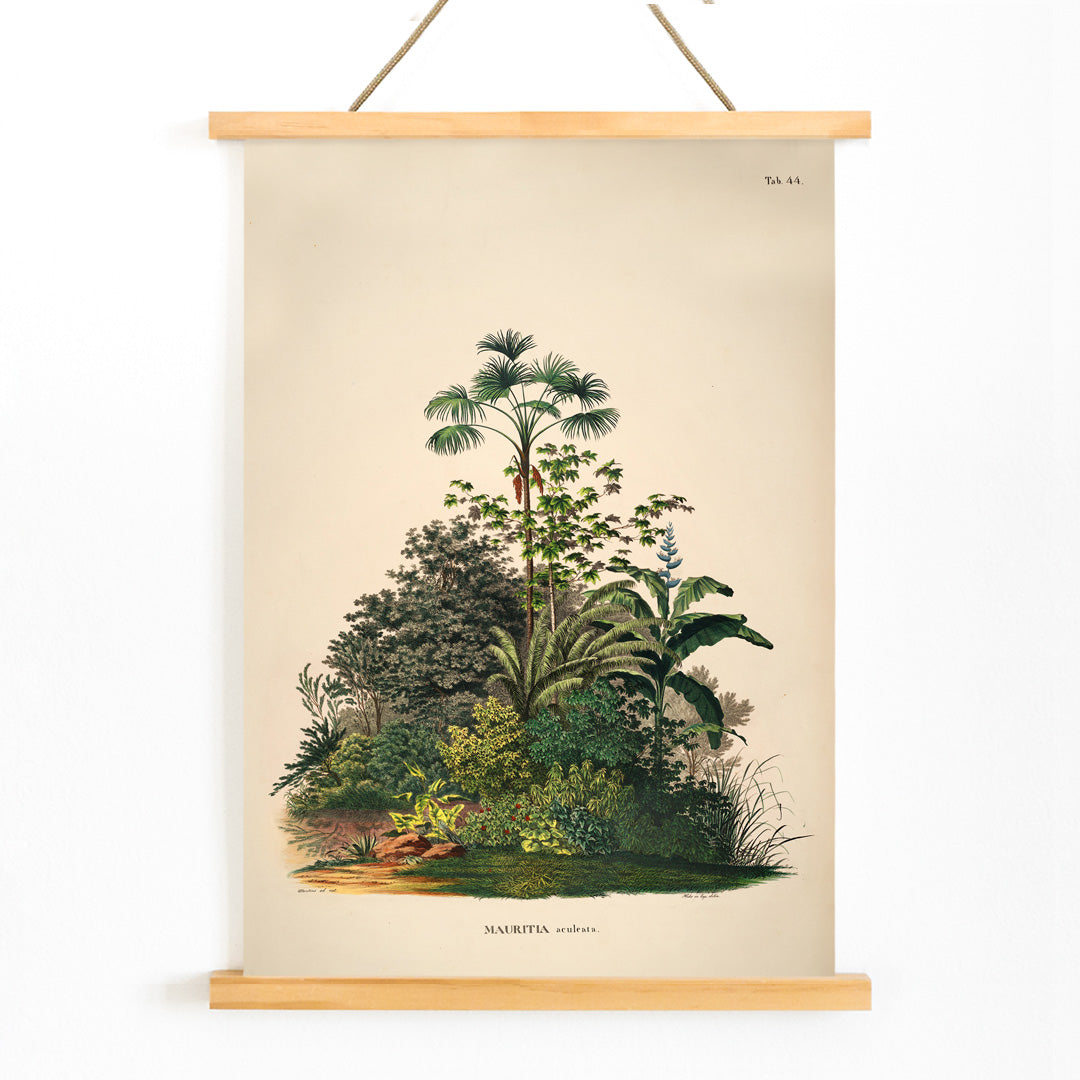
This illustration of Mauritia Armata was created during a period of intense botanical exploration, when scientists sought to catalog the world’s plant diversity through detailed studies and lavishly illustrated volumes. Such plates were essential tools for botanists, enabling accurate identification and comparison of species across continents.
Rather than serving as decorative art, the primary aim was to convey scientific knowledge—showing the structure, form, and unique features of the palm. Today, this vintage botanical print stands as a testament to the era’s spirit of discovery and the enduring value of science-inspired wall art.
Style & Characteristics
The composition features a central, meticulously rendered palm specimen, accompanied by smaller, labeled details that highlight key botanical features. The precise linework and careful arrangement reflect the disciplined approach of early scientific illustration.
Soft green hues are set against a warm beige background, creating a calm and archival atmosphere. The overall mood is one of clarity and quiet focus, appealing to admirers of botanical art prints and those drawn to interiors with green-toned wall decor.
In Interior Design
This botanical print brings a sense of tranquility and order to home offices, reading nooks, or bedrooms. Its vintage character pairs well with Scandinavian, minimalist, or classic interiors, and it can add structure to eclectic spaces filled with natural textures and plants.
Displayed with light woods, neutral walls, or black accents, the print’s gentle green tones echo nearby foliage. It layers beautifully into gallery walls with maps, still lifes, or other natural history pieces, especially when framed with a simple, modern profile.