


You may also like
-

Southern Sky Star Poster Poster
The Institute of Leipzig · 1854 · Detailed southern sky print featuring crisp star points and fine constellation lines
Poster from CHF 9 · Framed from CHF 16
-

Map of the moon Poster
The Institute of Liepzig · 1903 · Detailed lunar map poster with crater labels and soft grey shading on beige
Poster from CHF 9 · Framed from CHF 16
-

Spectral Analysis Poster
The Institute of Liepzig · 1973 · Vibrant spectral bars poster echoing lab charts with crisp scientific geometry
Poster from CHF 9 · Framed from CHF 16
-

Milky Way North Hemisphere Poster
Institute of Leipzig · 1949 · Detailed northern sky poster charting constellations across a luminous Milky Way band
Poster from CHF 9 · Framed from CHF 16


-

"Very nice Posters. The quality is amazing and we received it very quickly !"
-

"A shop to visit absolutely. Huge selection of posters. We spent more than an hour there !"
-

"Perfect to find gift. Price are very good. An they can frame and pack it on site"


About the Artist
The Institute of Liepzig represents the early twentieth-century tradition of scientific and educational publishing, when charts and diagrams were crafted for clarity and accessibility. Rather than bearing a single artist’s signature, works like this were typically the result of collaboration among astronomers, draftsmen, and printers.
In 1910, this collaborative approach reflected a broader European enthusiasm for visual knowledge, as educational materials became essential in classrooms and private studies. The Institute’s legacy endures in archival works that appeal to collectors interested in science posters and prints and the history of astronomy.
The Artwork
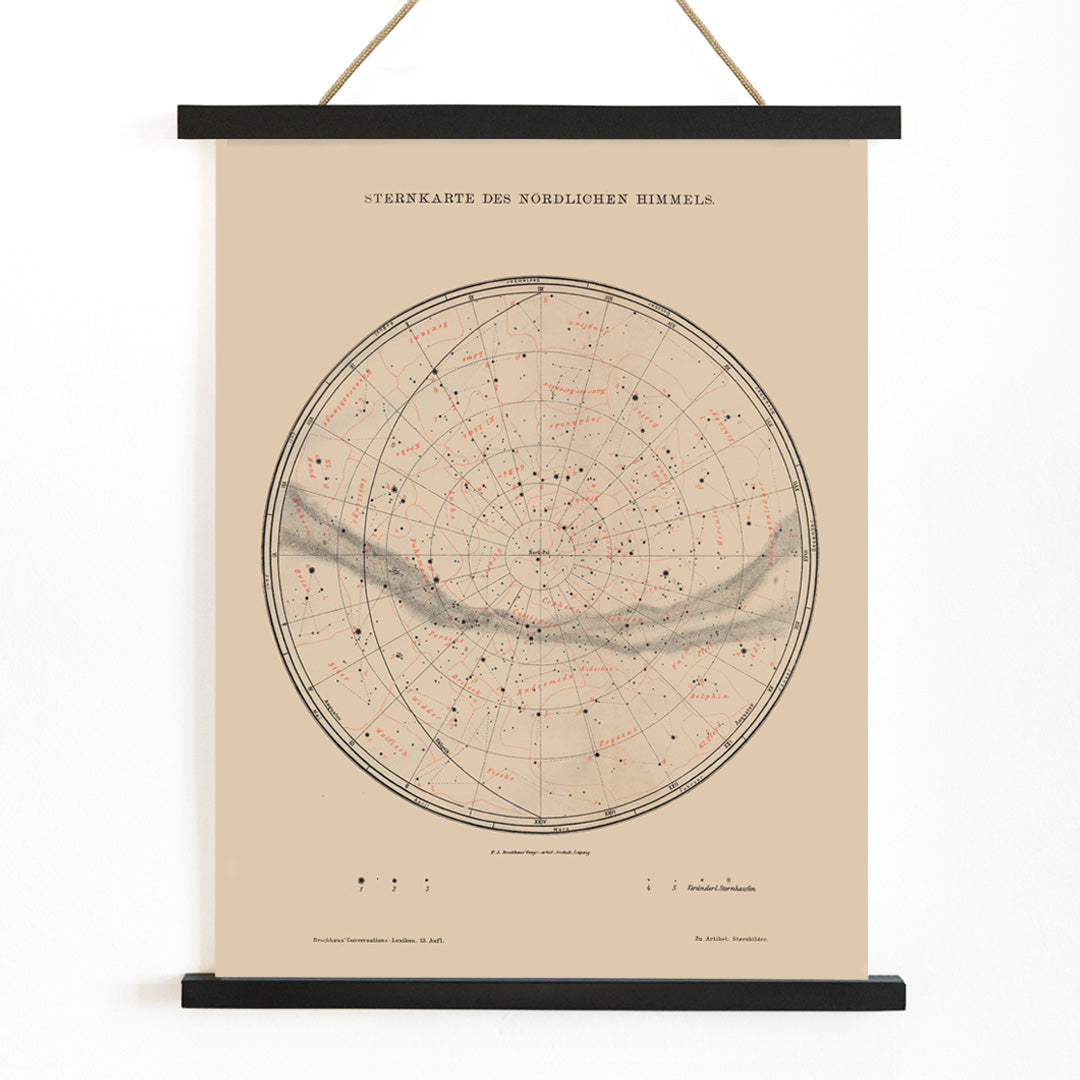
This Northern Sky star chart emerged during the golden age of popular astronomy, a period when advances in telescopes and the spread of public lectures encouraged amateur stargazing. Designed as an educational tool, the chart organizes the night sky into named constellations and reference coordinates, helping viewers make sense of the stars above.
Originally, such posters were used in schools and observatories to foster curiosity about celestial phenomena and to provide a reliable guide to seasonal changes in the night sky. Today, it stands as a testament to the era’s dedication to accessible scientific knowledge, complementing our space wall art for those inspired by exploration.
Style & Characteristics
The chart features precise black linework and clear typography on a warm beige background, accented by subtle red highlights. Stars are depicted in varying sizes to indicate their relative brightness, while fine lines connect the constellations and trace the underlying coordinate grid.
The composition is centered within a circular field, creating a sense of order and immersion. The mood is studious and contemplative, with a slightly nostalgic air that makes the poster an understated yet elegant decorative piece, suitable for a gallery wall or study.
In Interior Design
This vintage-inspired celestial poster brings a thoughtful focal point to offices, libraries, hallways, or bedrooms. Its palette of beige, black, and red pairs well with oak, walnut, dark metals, and deep blue accents, fitting seamlessly into minimalist or Scandinavian interiors.
For a harmonious display, combine it with cartographic works from our maps collection and allow ample space to appreciate its detailed design. Framed simply, it becomes a timeless accent for astronomy enthusiasts and design-conscious collectors.