


You may also like
-
Muscinae–Laubmoose Poster
Ernst Haeckel · 1904 · Detailed scientific print of leafy moss forms arranged like a natural cabinet study
Poster from CHF 9 · Framed from CHF 16
Regular price From CHF 6.00Regular price -
Trochilidae Poster
Ernst Haeckel · 1904 · Detailed hummingbird scientific print combining natural history precision with ornamental elegance
Poster from CHF 9 · Framed from CHF 16
Regular price From CHF 6.00Regular price -
Siphonophorae Poster
Ernst Haeckel · 1866 · Intricate siphonophore scientific print with floating forms in crisp blues and reds
Poster from CHF 9 · Framed from CHF 16
Regular price From CHF 6.00Regular price -
Actiniae Poster
Ernst Haeckel · 1904 · Detailed sea anemone scientific print with radiant tentacles arranged like jeweled marine flowers
Poster from CHF 9 · Framed from CHF 16
Regular price From CHF 6.00Regular price


-

"Very nice Posters. The quality is amazing and we received it very quickly !"
-

"A shop to visit absolutely. Huge selection of posters. We spent more than an hour there !"
-

"Perfect to find gift. Price are very good. An they can frame and pack it on site"


About the Artist
Ernst Haeckel was a German biologist, illustrator, and advocate for evolutionary science whose intricate images bridged the worlds of research and aesthetics. His work played a pivotal role in popularizing scientific discoveries, translating complex observations of nature into visually compelling forms that captivated both scientists and the public.
This 1904 plate is part of his influential portfolio Kunstformen der Natur, a landmark in both scientific illustration and decorative art. Haeckel’s legacy endures among collectors of science wall art and those who appreciate the intersection of art and natural history, standing alongside works by other famous artists in curated collections.
The Artwork
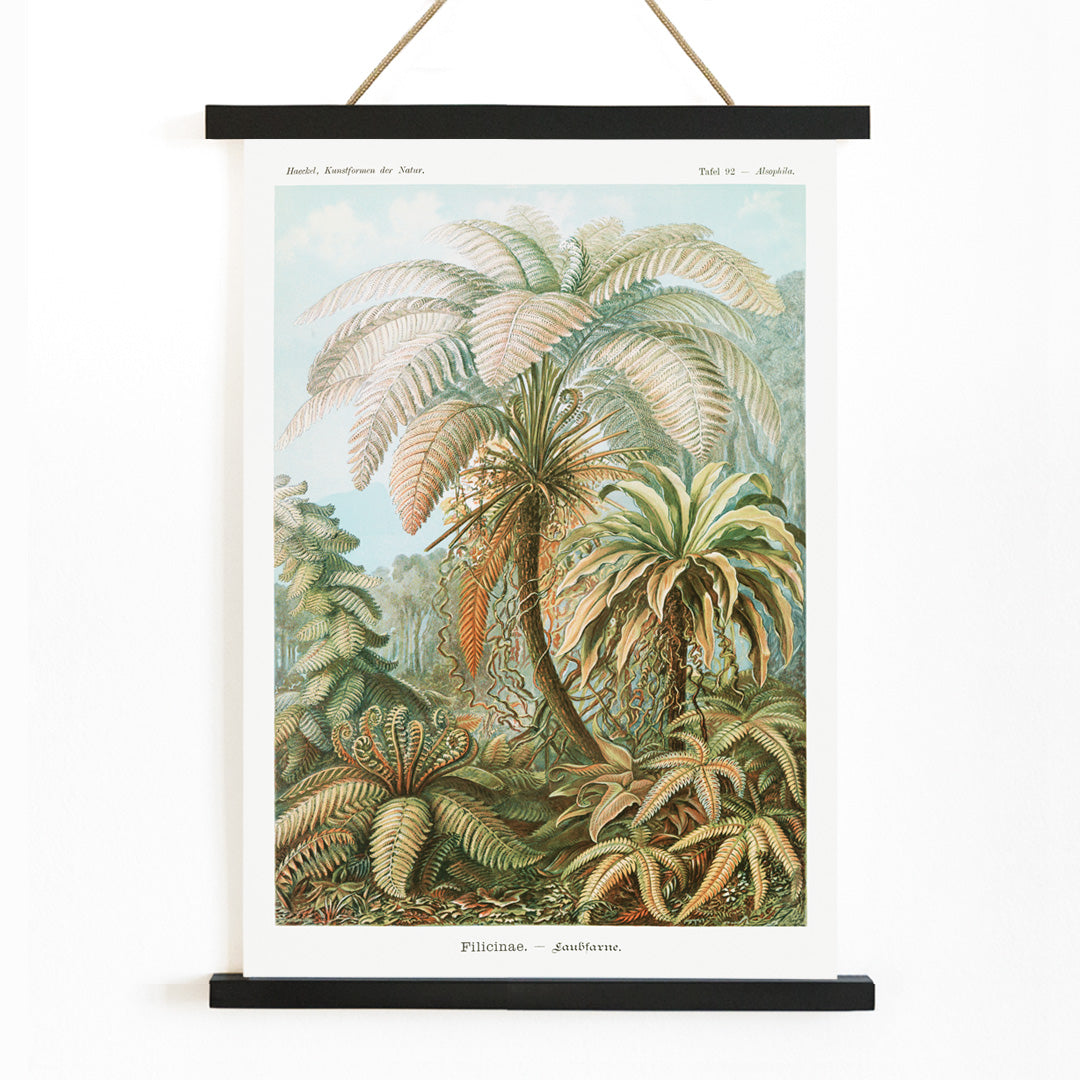
Filicinae Laubfarne was created during a period when advances in microscopy and taxonomy were transforming botanical science. Haeckel’s illustration highlights ferns as ancient survivors, emphasizing their evolutionary significance in a time when plant classification was rapidly evolving. The plate served both as a scientific reference and as an inspirational image, reflecting the era’s belief that nature’s forms could reveal hidden order and beauty.
Commissioned as part of a published series, this work was intended to educate and inspire, making scientific knowledge accessible to a broader audience. Its clarity and structure echo the early twentieth-century pursuit of understanding the natural world through both observation and artistry.
Style & Characteristics
The composition features a harmonious arrangement of various fern species, from broad mature fronds to delicate, unfurling fiddleheads. Each plant is rendered with crisp outlines and subtle tonal gradations, giving the image a sense of depth and precision reminiscent of museum plates.
The palette consists of lush greens and earthy browns set against a warm beige background, creating a tranquil and scholarly atmosphere. The symmetrical layout and ornamental detailing nod to Art Nouveau influences, making this botanical print both scientifically accurate and visually elegant.
In Interior Design
This fern botanical print brings a sense of calm and organic rhythm to living rooms, studies, bedrooms, or hallways. Its refined style complements Scandinavian, Japandi, and classic interiors, while also softening industrial spaces with natural forms.
Pair it with wood tones, linen, and ceramics, and enhance its effect with olive or sage textiles and muted metallic accents. For a cohesive gallery wall, consider matching it with other botanical prints or coordinating green decor for a harmonious palette.