


You may also like
-

Lastrea dilatato Poster
Anna Atkins · 1850 · Fern cyanotype botanical print with airy fronds set against saturated blue
Poster from CHF 9 · Framed from CHF 16
-

Fern Poster
Anna Atkins · 1850 · Classic cyanotype fern print with crisp white fronds on deep blue
Poster from CHF 9 · Framed from CHF 16
-

Woodwardia virginica Poster
Anna Atkins · 1850 · Iconic cyanotype fern print with crisp frond silhouettes on deep Prussian blue
Poster from CHF 9 · Framed from CHF 16
-

Ceylon Poster
Anna Atkins · 1850 · Luminous fern print in classic cyanotype blue with delicate white botanical silhouettes
Poster from CHF 9 · Framed from CHF 16


-

"Very nice Posters. The quality is amazing and we received it very quickly !"
-

"A shop to visit absolutely. Huge selection of posters. We spent more than an hour there !"
-

"Perfect to find gift. Price are very good. An they can frame and pack it on site"


About the Artist
Anna Atkins was a pioneering British botanist and one of the first women to make significant contributions to photography. In the 1840s, she utilized the newly invented cyanotype process, developed by John Herschel, to document botanical specimens. Atkins is widely recognized for publishing the first book illustrated with photographic images, using this innovative technique to advance both science and art.
Her cyanotypes bridged the worlds of natural history and early photographic experimentation, offering a new way to record and share plant specimens. Today, her work is valued not only for its scientific precision but also for its quiet artistry and historical significance within the evolution of photographic printing.
The Artwork
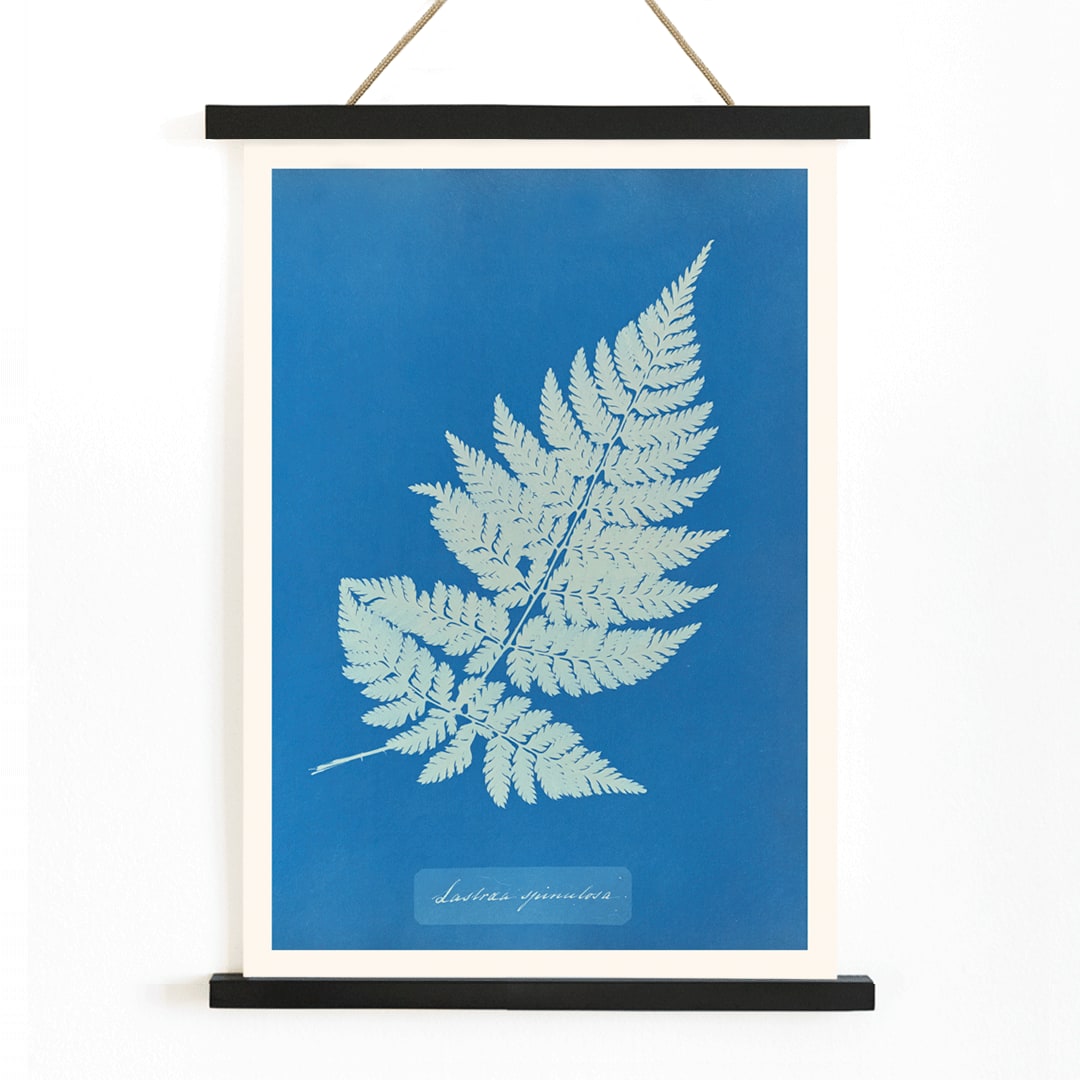
Lastrea Spinulosa was created during the Victorian fern craze, a time when collecting and cataloguing ferns became a widespread passion in Britain. Atkins produced this cyanotype as part of her efforts to systematically document plant species, making botanical knowledge accessible to a wider audience. The direct contact printing method she employed allowed her to capture the intricate details of each specimen, preserving them for study and appreciation.
This work reflects the era’s fascination with the natural world and the desire to merge scientific inquiry with aesthetic presentation. It stands as a testament to how photography could democratize scientific information and transform it into enduring works of art.
Style & Characteristics
The cyanotype features a striking contrast between the deep, saturated blue background and the delicate white silhouette of the fern. Each leaflet and branching vein is rendered with remarkable clarity, a hallmark of the contact printing process. The composition is centered and uncluttered, allowing the specimen to command attention within ample negative space.
The overall effect is both archival and serene, giving the print a timeless quality. Its minimalist elegance makes it well suited for contemporary interiors, and it pairs beautifully with other early photographic prints or botanical wall art for a cohesive display.
In Interior Design
This vintage botanical print introduces a sense of calm and focus to living spaces such as bedrooms, studies, or hallways. The cool blue and white palette complements natural materials like wood, linen, and stone, fitting seamlessly into Scandinavian, minimalist, or classic decor schemes.
For a curated gallery wall, consider combining it with cream mats and simple frames, or display it alongside other nature-inspired works. Its subtle yet distinctive presence also harmonizes with blue tone wall art, enhancing both modern and vintage-inspired interiors.