


You may also like
-
Geometric Lines and colors 1 Poster
MORYARTY · 1920 · Bauhaus-inspired abstract poster with intersecting black lines and blocks of red, blue, and yellow
Poster from CHF 9 · Framed from CHF 16
Regular price From CHF 6.00Regular price -
Geometric Lines and colors 2 Poster
MORYARTY · 2018 · Dynamic geometric poster with intersecting black lines and bold primary shapes on white
Poster from CHF 9 · Framed from CHF 16
Regular price From CHF 6.00Regular price -
Lignes géométriques et ondoyantes Poster
Myriam Thyes · 2014 · Dynamic geometric poster with wavy lines and bold black structure on warm beige
Poster from CHF 9 · Framed from CHF 16
Regular price From CHF 6.00Regular price -
Meditation Poster
Alexej von Jawlensky · 1937 · Meditative face art print with bold black contours and radiant pink, blue, and green
Poster from CHF 9 · Framed from CHF 16
Regular price From CHF 6.00Regular price


-

"Very nice Posters. The quality is amazing and we received it very quickly !"
-

"A shop to visit absolutely. Huge selection of posters. We spent more than an hour there !"
-

"Perfect to find gift. Price are very good. An they can frame and pack it on site"


About the Artist
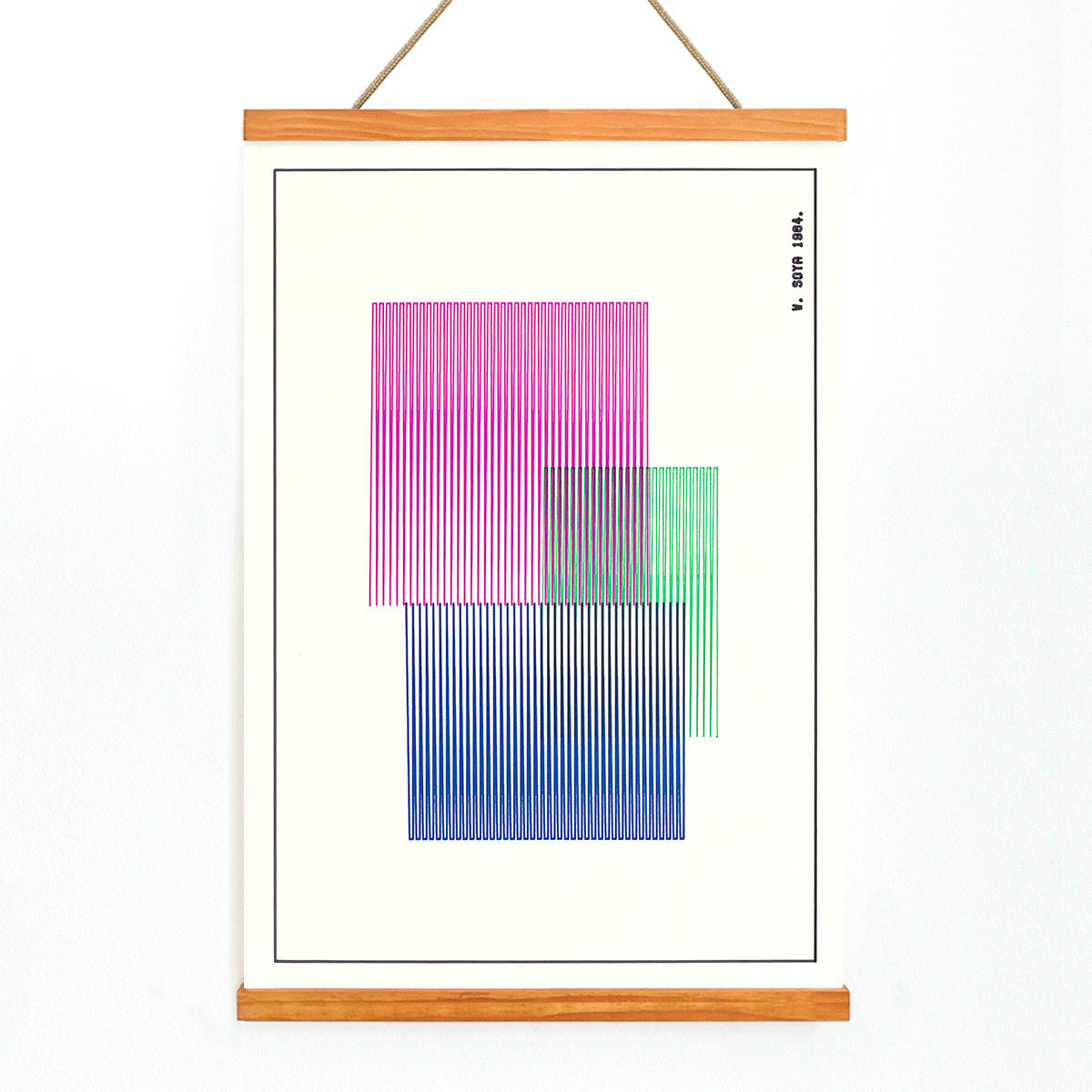
W. Soya is credited with this 1964 design, created during a period when modernist graphic art was bridging the gap between fine art and everyday life. Although little is known about Soya’s biography, the work reflects the international embrace of geometric abstraction that defined much of mid-century visual culture.
Collectors interested in structured forms and vivid palettes will find resonance with this vintage abstract poster, which shares a design ethos with works in our Bauhaus-inspired posters collection.
The Artwork
Red, Blue, Green embodies the spirit of 1960s modernism, where artists distilled visual experience into essential forms and relationships. Created at a time of architectural innovation and optimism, this artwork offered viewers a new way to engage with color and composition in their daily environments.
Rather than representing a specific subject, the piece explores the dynamics of perception—how primary colors interact, how geometric forms create rhythm, and how abstraction can convey energy and order. It stands as a testament to the era’s belief in progress and clarity through design.
Style & Characteristics
The composition features sharply defined geometric shapes in saturated red, blue, and green, set against a clean white background. Each color block is precisely edged, creating a striking interplay of contrast and balance.
The overall effect is both dynamic and orderly, with crisp lines and bold hues guiding the viewer’s eye across the surface. This minimalist abstract style aligns with works found in our abstract art prints and brings a graphic, contemporary presence to any space.
In Interior Design
This vintage poster is especially suited to interiors that emphasize structure and clarity, such as mid-century modern, Scandinavian, and minimalist spaces. It works well above a streamlined sofa, in a hallway as a focal point, or in an office where visual energy is desired.
The vivid colors complement white walls, light woods, chrome, and black accents, but can also enliven more subdued palettes. For a cohesive display, pair it with other minimalist posters in simple frames and coordinated formats.