


You may also like
-

Actiniae Poster
Ernst Haeckel · 1904 · Detailed sea anemone scientific print with radiant tentacles arranged like jeweled marine flowers
Poster from CHF 9 · Framed from CHF 16
-

Siphonophorae Poster
Ernst Haeckel · 1866 · Intricate siphonophore scientific print with floating forms in crisp blues and reds
Poster from CHF 9 · Framed from CHF 16
-

Discomedusae Poster
Ernst Haeckel · 1904 · Detailed jellyfish scientific print with floating bells and lace-like tentacles
Poster from CHF 9 · Framed from CHF 16
-

Peromedusae Poster
Ernst Haeckel · 1904 · Intricate jellyfish scientific print with floating bells and lace-like tentacles
Poster from CHF 9 · Framed from CHF 16


-

"Very nice Posters. The quality is amazing and we received it very quickly !"
-

"A shop to visit absolutely. Huge selection of posters. We spent more than an hour there !"
-

"Perfect to find gift. Price are very good. An they can frame and pack it on site"


About the Artist
Ernst Haeckel was a German biologist, illustrator, and a key figure in popularizing evolutionary theory around the turn of the twentieth century. His work bridged the gap between scientific observation and the decorative arts, influencing the development of Art Nouveau and modern organic design. Haeckel’s illustrations brought the wonders of marine biology to a broader audience, blending scientific rigor with visual elegance.
His legacy endures in both scientific and artistic circles, as his images continue to inspire those fascinated by the natural world and its hidden structures.
The Artwork
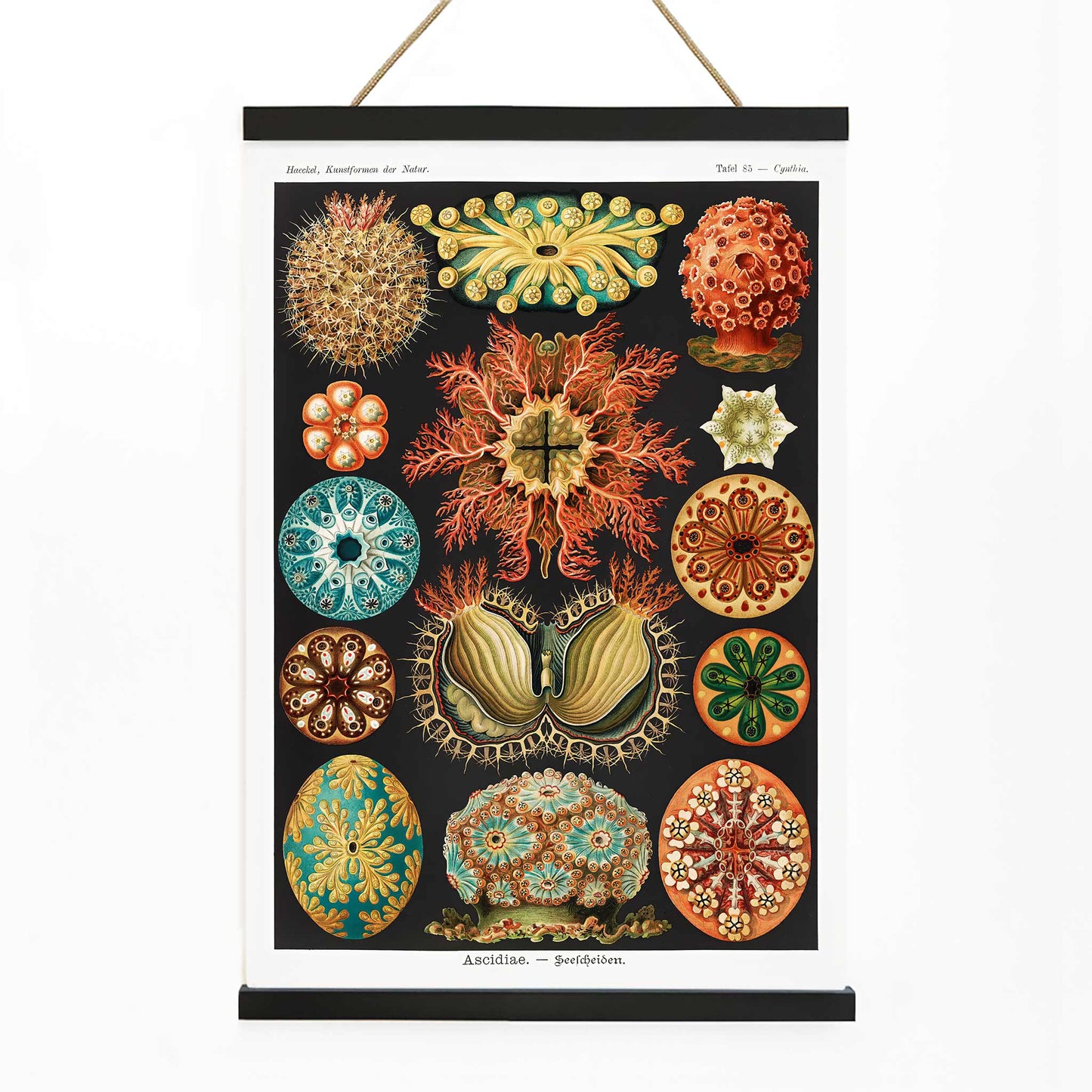
Ascidiae is part of Haeckel’s renowned Kunstformen der Natur series, created to showcase the diversity and underlying unity of living organisms. Produced during an era of rapid advances in microscopy and marine exploration, these plates served as both scientific references and visual arguments for the interconnectedness of nature. The focus here is on ascidians, or sea squirts, whose unusual forms and life cycles intrigued biologists studying classification and development.
This print reflects Haeckel’s mission to reveal the beauty and complexity of even the most overlooked marine life, inviting viewers to appreciate taxonomy as an art form in itself.
Style & Characteristics
The composition features multiple ascidian specimens arranged in a symmetrical, almost ornamental layout that encourages comparison of their varied shapes and branching structures. Haeckel’s technique combines precise linework with subtle shading, ensuring scientific clarity while highlighting the natural rhythm and symmetry of the forms.
Set against a deep, dark background, the palette glows with warm reds, oranges, and yellows, accented by touches of green. This creates a luminous, aquatic atmosphere that is both analytical and visually rich, making the print a striking example of vintage scientific illustration.
In Interior Design
This vintage scientific print adds intellectual depth and visual intrigue to living rooms, studies, or hallways. It complements mid-century modern, minimalist, or eclectic interiors, especially when paired with dark wood, brass accents, or crisp white walls.
For a cohesive look, display it alongside other scientific wall art or sea and ocean prints, and consider mixing it with classic art posters. The warm color palette pairs beautifully with terracotta, muted greens, and black frames for a refined, gallery-inspired finish.