


You may also like
-

Rivers and Lakes Poster
James Reynolds · 1851 · Panoramic rivers and lakes comparison poster blending cartography with early infographic clarity
Poster from CHF 9 · Framed from CHF 16
-

Volcanoes and Earthquakes Poster
James Reynolds · 1849 · Detailed world map vintage print charting volcanic belts and earthquake zones
Poster from CHF 9 · Framed from CHF 16
-

Principal buildings in the world Poster
James Reynolds · 1850 · Comparative architectural poster featuring world landmarks in sepia linework and blue accents
Poster from CHF 9 · Framed from CHF 16
-

Mountains Poster
James Reynolds · 1851 · Educational mountain-height vintage print combining labeled silhouettes into a dramatic panorama
Poster from CHF 9 · Framed from CHF 16


-

"Very nice Posters. The quality is amazing and we received it very quickly !"
-

"A shop to visit absolutely. Huge selection of posters. We spent more than an hour there !"
-

"Perfect to find gift. Price are very good. An they can frame and pack it on site"


About the Artist
James Reynolds was a prominent British mapmaker active in the mid-nineteenth century, a time when advances in printing technology made detailed cartographic works widely accessible. His maps were valued not only by scholars and explorers but also by a growing public eager to visualize the expanding world. Reynolds contributed to an era when geography became central to education and intellectual curiosity, with maps serving as both practical tools and refined decorative objects.
Maps like this one were often displayed in classrooms, libraries, and salons, reflecting a belief in the power of knowledge and the importance of understanding the physical world. Today, Reynolds’s work is appreciated by collectors of historical geography and those who value the intersection of art and science in vintage decor.
The Artwork
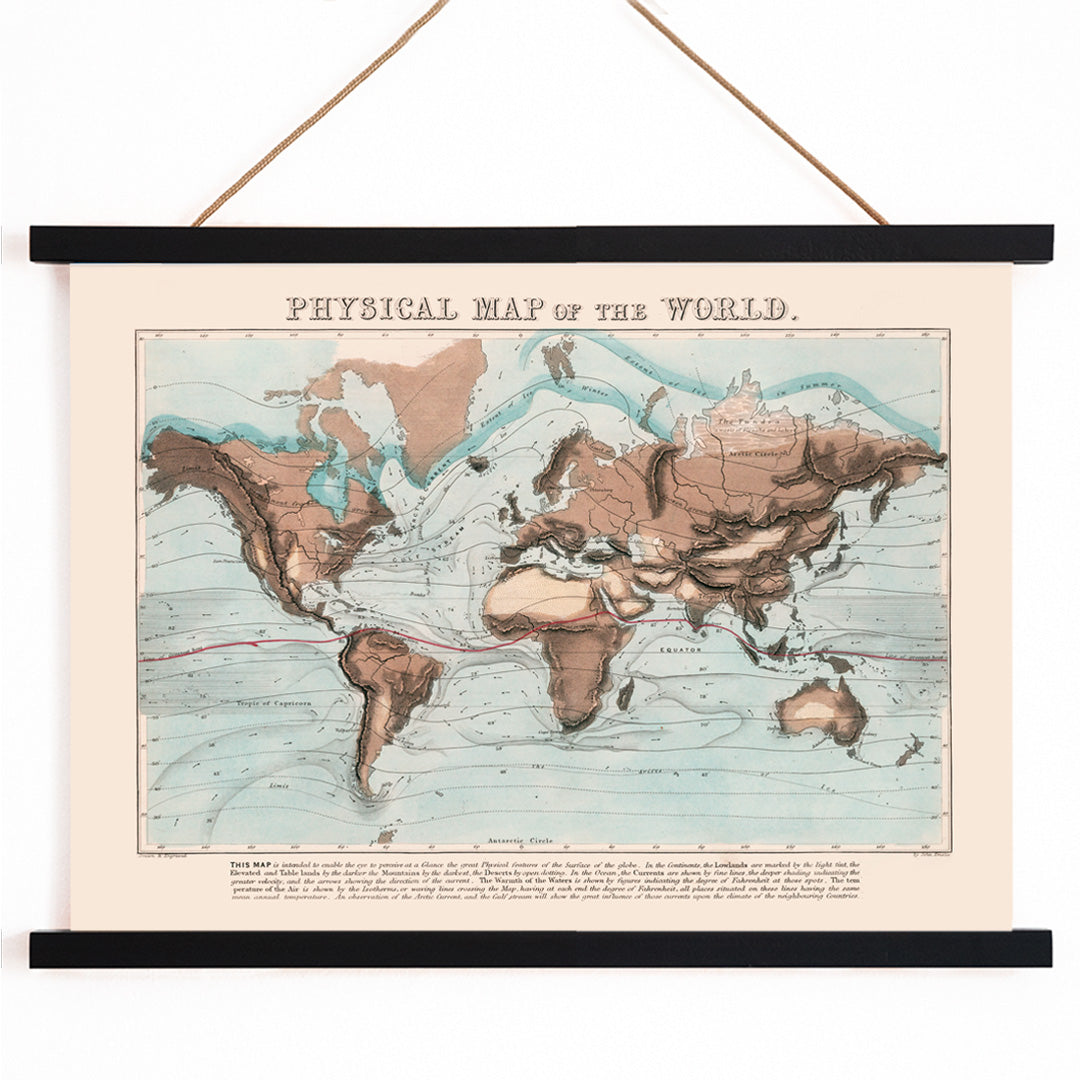
This 1850 physical world map presents the Earth not by political boundaries, but through its natural features—mountain ranges, river systems, and oceanic expanses. Created at a time when scientific exploration and global awareness were on the rise, the map embodies the Victorian fascination with discovery and the desire to organize knowledge visually. It would have been used as an educational reference, supporting lessons in natural history and geography, and as a symbol of intellectual engagement in the home.
For enthusiasts of vintage maps and admirers of educational art, this piece offers a window into how nineteenth-century viewers understood their place in the world. It remains a quietly authoritative presence in any thoughtful interior.
Style & Characteristics
The map features a rectangular composition with finely engraved coastlines, mountain relief, and a network of latitude and longitude lines. Place names are rendered in crisp black type, while subtle hand coloring distinguishes blue oceans from green and tan landmasses, all set against a warm beige background. The careful balance of color and linework gives the map clarity and a sense of calm order.
The overall mood is studious and serene, making it ideal for a refined study or library. For those drawn to cool tones, our blue toned wall art collection offers complementary pieces for a cohesive display.
In Interior Design
This vintage print lends sophistication to studies, libraries, entryways, or living rooms, anchoring gallery walls with its understated presence. Its palette pairs well with wood, leather, and brass, fitting seamlessly into classic, minimalist, or eclectic interiors.
To enhance its impact, echo the map’s beige and blue tones in textiles or ceramics, or explore our frames collection to create a polished focal point.