


You may also like
-
Plankton I Poster
Institute of Liepzig · 2011 · Detailed marine algae scientific print with crisp black linework and specimen-like arrangement
Poster from CHF 9 · Framed from CHF 16
Regular price From CHF 6.00Regular price -
Swimming Polyps Poster
Institute of Liepzig · 2018 · Intricate marine scientific print of swimming polyps and jellyfish in cool sea tones
Poster from CHF 9 · Framed from CHF 16
Regular price From CHF 6.00Regular price -
Jellyfish Poster
Institute of Liepzig · 2017 · Luminous jellyfish poster floating on deep blue with delicate trailing tentacles
Poster from CHF 9 · Framed from CHF 16
Regular price From CHF 6.00Regular price -
Planet System Poster
Institute of Liepzig · 1988 · Vintage solar system chart poster with green and beige tones and detailed orbits
Poster from CHF 9 · Framed from CHF 16
Regular price From CHF 6.00Regular price


-

"Very nice Posters. The quality is amazing and we received it very quickly !"
-

"A shop to visit absolutely. Huge selection of posters. We spent more than an hour there !"
-

"Perfect to find gift. Price are very good. An they can frame and pack it on site"


About the Artist
The Institute of Liepzig is a contemporary studio known for merging scientific observation with modern design sensibilities. Drawing inspiration from research plates, museum archives, and educational diagrams, the studio approaches each project as both a visual exploration and a tool for learning. Their work often blurs the boundaries between art and science, making complex subjects accessible and visually engaging.
Plankton II, created in 2022, exemplifies this philosophy by transforming microscopic life into a subject of artistic focus. The piece reflects a fascination with the unseen foundations of our world, inviting viewers to appreciate the intricate beauty and ecological importance of plankton.
The Artwork
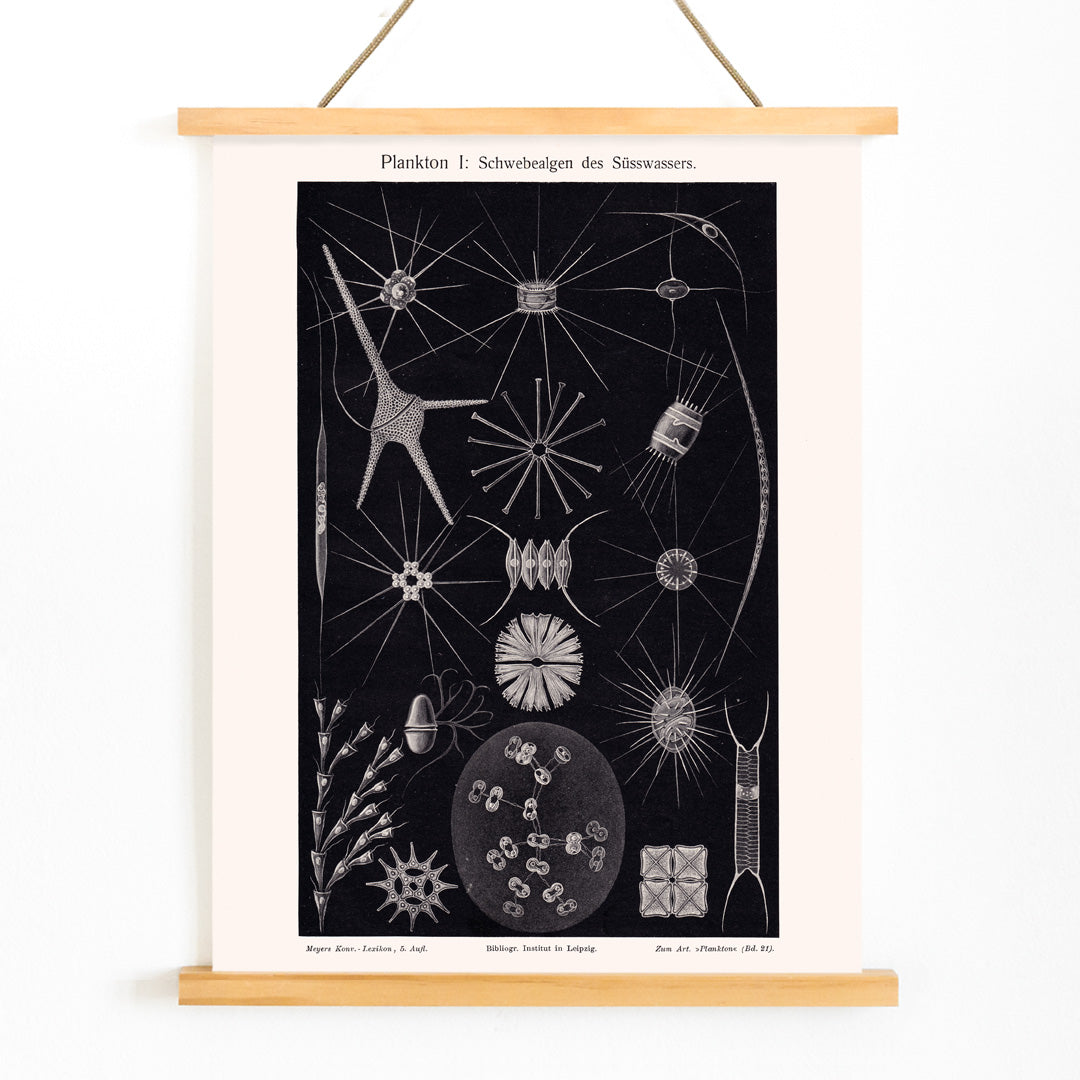
Plankton II centers on freshwater plankton, the minute organisms essential to aquatic ecosystems and global oxygen cycles. This artwork serves as a visual reminder of the critical roles these organisms play in sustaining life, despite their invisibility to the naked eye.
Conceived in the tradition of educational wall charts, the piece bridges scientific illustration with contemporary aesthetics. It encourages viewers to slow down and observe, echoing the renewed interest in biodiversity and environmental awareness in today's society.
Style & Characteristics
This black and white composition arranges various plankton forms in a precise, plate-like layout. Delicate linework and sharply defined contours evoke the discipline of microscopic study, while generous spacing lends the print a sense of clarity and calm.
The high-contrast monochrome palette highlights structural details, giving the scientific print a modern, minimalist feel. The mood is contemplative and focused, aligning it with science posters and archival-inspired black and white prints that reward close examination.
In Interior Design
As a monochrome art print, Plankton II integrates seamlessly into minimalist, Scandinavian, and modern interiors. Its clean lines and scientific subject matter make it suitable for home offices, studios, hallways, or even bathrooms where an aquatic theme is fitting.
Pairing it with black or white frames, light woods, and soft grey textiles enhances its understated elegance. It can serve as a focal point in a gallery wall of natural history or complement minimalist wall art with an intellectual, specimen-like presence.