


You may also like
-

Adiantum tenerum Poster
Anna Atkins · 1850 · Delicate cyanotype fern print with crisp white fronds on deep blue ground
Poster from CHF 9 · Framed from CHF 16
-

Adiantum assimile Poster
Anna Atkins · 1850 · Fern cyanotype botanical print with crisp white fronds on deep Prussian blue
Poster from CHF 9 · Framed from CHF 16
-

Woodwardia virginica Poster
Anna Atkins · 1850 · Iconic cyanotype fern print with crisp frond silhouettes on deep Prussian blue
Poster from CHF 9 · Framed from CHF 16
-

Lastrea dilatato Poster
Anna Atkins · 1850 · Fern cyanotype botanical print with airy fronds set against saturated blue
Poster from CHF 9 · Framed from CHF 16


-

"Very nice Posters. The quality is amazing and we received it very quickly !"
-

"A shop to visit absolutely. Huge selection of posters. We spent more than an hour there !"
-

"Perfect to find gift. Price are very good. An they can frame and pack it on site"


About the Artist
Anna Atkins was a pioneering British botanist and photographer, celebrated for her innovative use of the cyanotype process to document plant life. Working in the Victorian era, she produced some of the earliest photographic books, using light-sensitive paper to create detailed images of botanical specimens. Atkins' work bridged the worlds of science and art, influencing both botanical study and the emerging field of photography.
Her cyanotypes are now regarded as milestones in both scientific illustration and early photographic art, resonating with collectors interested in vintage photography prints and scientific illustration.
The Artwork
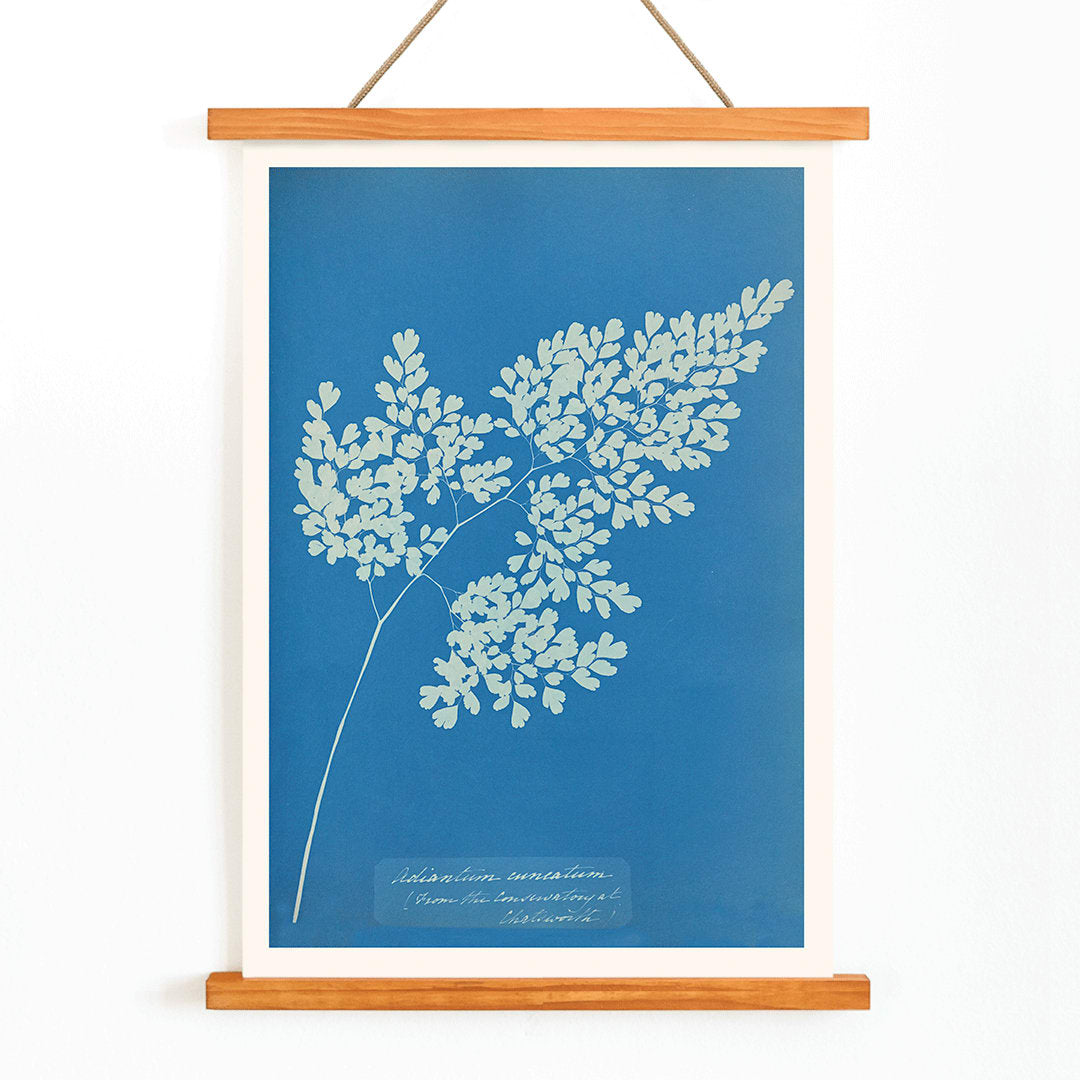
Adiantum cuneatum was created during a period when cataloguing and sharing botanical knowledge was central to scientific progress. Atkins' decision to use the cyanotype process allowed her to capture the fern specimen with exceptional accuracy, preserving its unique structure as a direct impression. This method was particularly valued in the mid-nineteenth century, when botanical albums were exchanged among scholars and enthusiasts as both reference and keepsake.
Such works reflect the era's fascination with natural history and the desire to make scientific study visually accessible. This print stands as a testament to the intersection of innovation and tradition in Victorian botanical documentation.
Style & Characteristics
The image features a single fern specimen rendered as a crisp white silhouette against a rich Prussian blue background. Each leaflet is finely detailed, with the plant's delicate structure appearing almost lace-like where it pressed closely to the paper. A small label at the bottom of the sheet reinforces its archival, specimen-based character.
The overall mood is tranquil and contemplative, combining scientific precision with a minimalist aesthetic. The cyanotype technique lends the print a luminous quality, making it an elegant addition to collections of botanical wall art or blue tones decor.
In Interior Design
This blue-and-white botanical print introduces a sense of calm and order to living rooms, bedrooms, or workspaces. Its refined simplicity complements Scandinavian, minimalist, and modern classic interiors, while also providing a serene counterpoint in more eclectic settings.
Pair it with natural materials like wood and linen, or echo its palette with indigo textiles and ceramics. The print layers beautifully with other botanical pieces, enhancing a curated gallery wall or a focused blue-themed display.