


You may also like
-

Twenty Tropical Shells Poster
Johann Gustav Hoch · 1750 · Detailed tropical shells print arranged like a collector plate on clean white ground
Poster from CHF 9 · Framed from CHF 16
-

Conchology Poster
Oliver Goldsmith · 1820 · Detailed seashell scientific print with crisp linework and an orderly specimen layout
Poster from CHF 9 · Framed from CHF 16
-

Tropical shells Poster
Johann Gustav Hochbrucker · 1837 · Detailed shell print presenting eleven tropical specimens in calm beige and umber tones
Poster from CHF 9 · Framed from CHF 16
-

Colored Mollusks Poster
Charles Dessalines d Orbigny · 1806 · Detailed mollusk shell print arranging specimens like a cabinet plate with crisp labels
Poster from CHF 9 · Framed from CHF 16


-

"Very nice Posters. The quality is amazing and we received it very quickly !"
-

"A shop to visit absolutely. Huge selection of posters. We spent more than an hour there !"
-

"Perfect to find gift. Price are very good. An they can frame and pack it on site"


About the Artist
Jacob de Later is recognized for his contributions to early 18th-century natural history illustration, a period when scientific curiosity and systematic classification were on the rise. Although little is documented about his personal life, his surviving works reflect the era’s dedication to cataloguing nature’s diversity for both scholars and collectors.
His prints were valued as reliable visual references, bridging the gap between scientific observation and artistic skill. They served as essential tools for study and discussion in an age when natural history was both a fashionable pursuit and a serious academic endeavor.
The Artwork
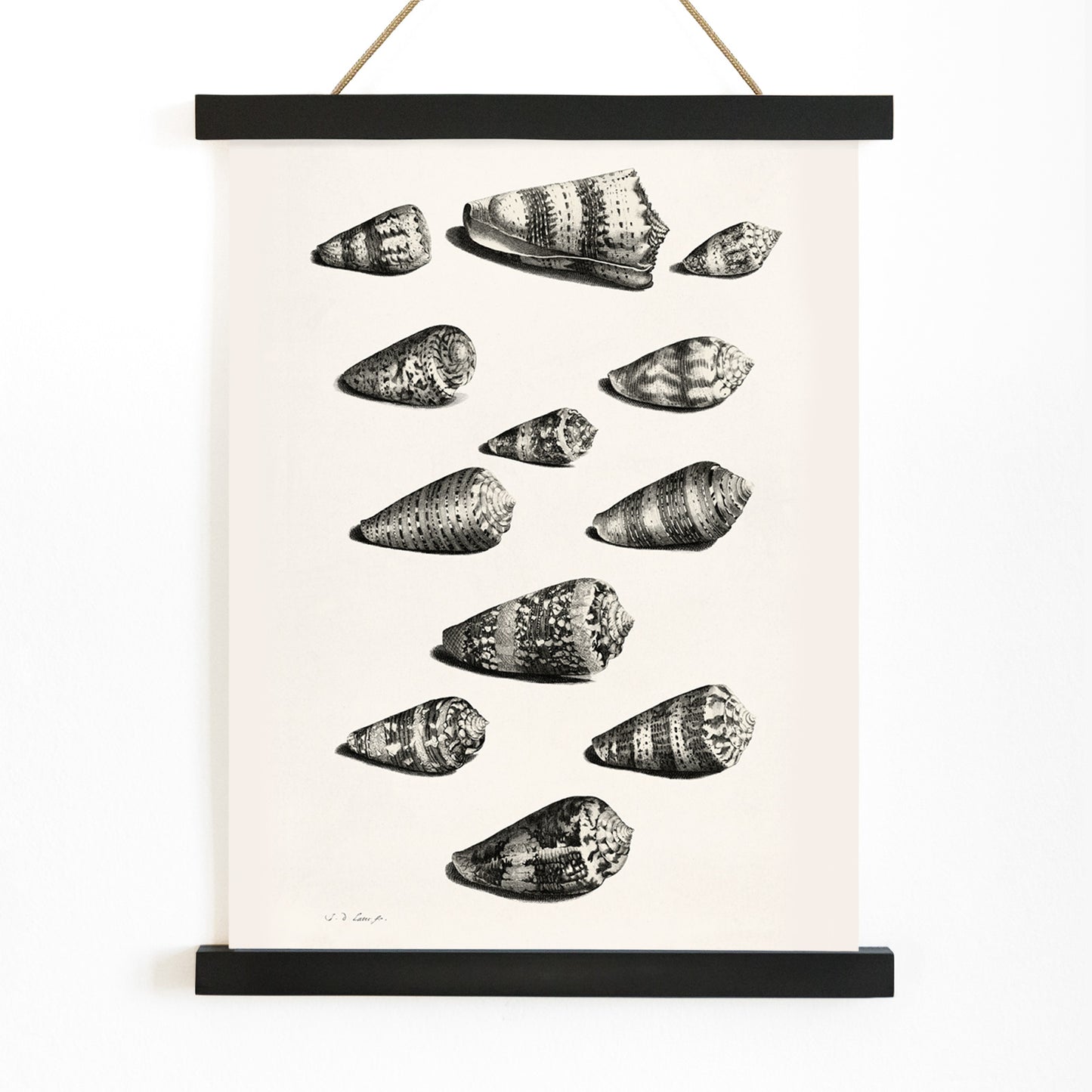
This print of twelve shells is rooted in the tradition of conchology, which captivated European collectors and naturalists during the Age of Enlightenment. As global trade expanded, exotic shells became prized objects in cabinets of curiosity, symbolizing exploration and the desire to understand the natural world’s complexity.
Created as a reference plate, the artwork was intended to facilitate comparison and identification, reflecting the period’s fascination with order and taxonomy. Its arrangement invites viewers to appreciate both the uniqueness and the systematic presentation of each specimen.
Style & Characteristics
The composition features twelve distinct shell studies, each meticulously drawn in black ink on a pale background. Fine linework and subtle hatching convey the textures and contours of the shells, emphasizing their structural variety without embellishment.
The monochrome palette lends the image a scholarly, archival quality, reminiscent of classic scientific illustration. The clarity and restraint of the drawing make it suitable for science-inspired interiors and those who appreciate black and white art, offering both visual interest and historical resonance.
In Interior Design
This vintage print complements spaces where calm and contemplation are valued, such as studies, libraries, or serene bathrooms. Its understated elegance pairs well with natural materials like wood and stone, fitting seamlessly into minimalist, coastal, or traditional settings.
For a cohesive display, consider grouping it with other animal illustrations or maintaining a monochrome theme with curated prints. Its timeless appeal makes it a thoughtful addition for those who appreciate natural history and refined design.