


You may also like
-
Human Skull Poster
Institute of Leipzig · 1924 · Detailed scientific print showing skull profiles and base view with crisp anatomical labeling
Poster from CHF 9 · Framed from CHF 16
Regular price From CHF 6.00Regular price -
Human Blood System Poster
Institute of Liepzig · 1906 · Detailed anatomical poster mapping blood circulation with red and blue vessels on beige
Poster from CHF 9 · Framed from CHF 16
Regular price From CHF 6.00Regular price -
Humain Brain Poster
Institute of Liepzig · 1869 · Detailed human brain scientific print with labeled anatomy on warm beige paper
Poster from CHF 9 · Framed from CHF 16
Regular price From CHF 6.00Regular price -
Planiglobes of the Earth I Poster
Institute of Liepzig · 1860 · Detailed hemispheric world map vintage print with crisp graticules and antique typography
Poster from CHF 9 · Framed from CHF 16
Regular price From CHF 6.00Regular price


-

"Very nice Posters. The quality is amazing and we received it very quickly !"
-

"A shop to visit absolutely. Huge selection of posters. We spent more than an hour there !"
-

"Perfect to find gift. Price are very good. An they can frame and pack it on site"


About the Artist
The Institute of Leipzig represents a tradition of academic medical illustration that was central to European scientific education around 1900. Rather than reflecting an individual artist’s vision, these institutional works were created by teams of illustrators and anatomists to serve as standardized teaching aids. Their purpose was to ensure accuracy and consistency in the way anatomy was presented to generations of students and professionals.
Such prints were commissioned by universities and medical faculties to support the rapid growth of modern medicine. They embody the era’s belief in visual learning and the importance of clear, accessible scientific communication, bridging the gap between research, education, and public understanding.
The Artwork
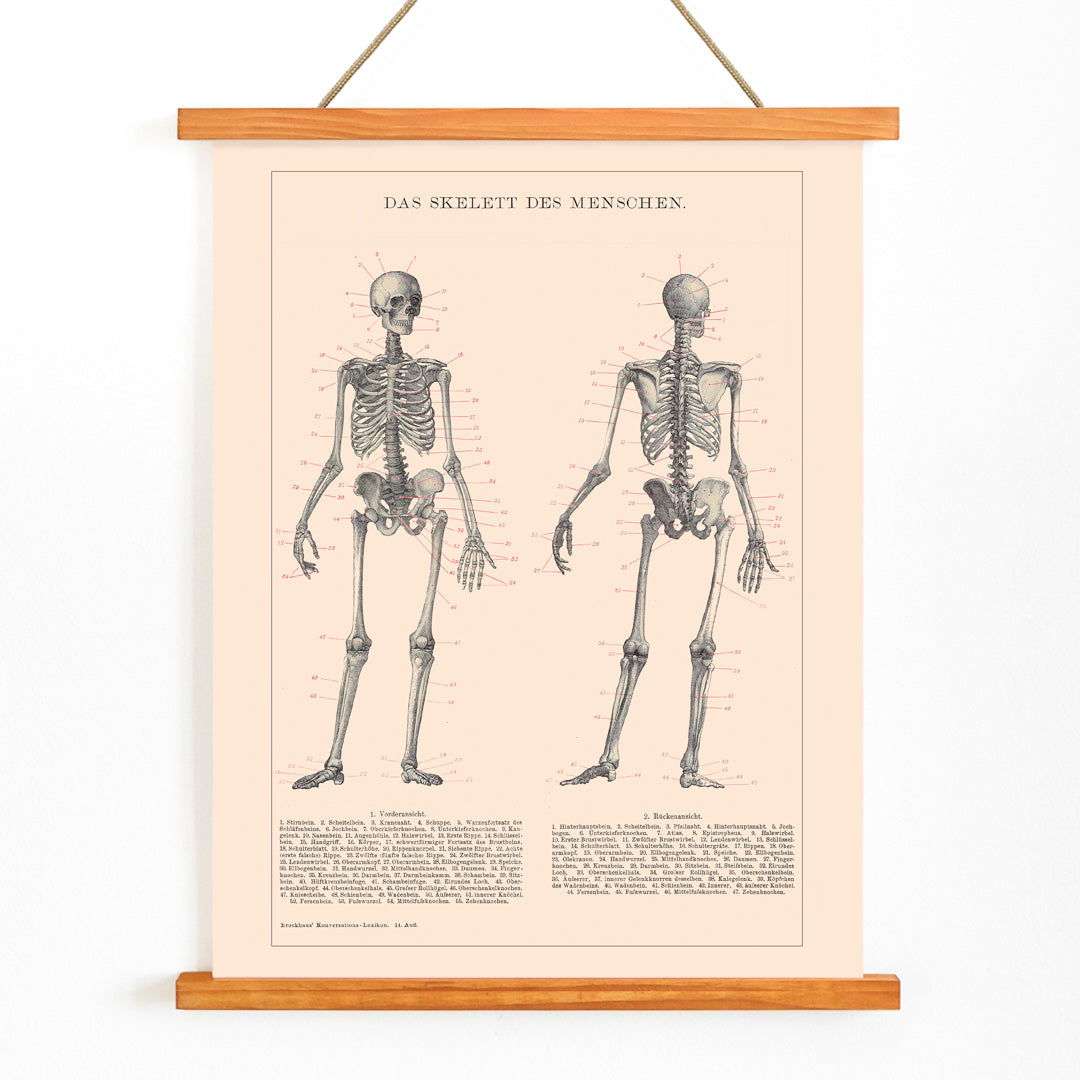
This anatomical chart of the human skeleton was produced during a period when medical education relied heavily on visual aids to convey complex information. The full-length skeletal figure was designed to provide students with a comprehensive reference for study and examination, making the structure of the human body immediately accessible.
Created at the turn of the 20th century, the print reflects a time when scientific institutions sought to democratize knowledge through detailed, accurate imagery. Today, it stands as both a historical document and a reminder of the enduring fascination with the human form in science and art.
Style & Characteristics
The composition features a centrally placed skeleton rendered with meticulous linework and subtle shading, emphasizing anatomical accuracy. The use of fine black lines and careful gradations of grey creates a sense of volume and clarity in the bones, particularly in the skull, ribcage, and limbs.
The restrained palette of beige, black, and grey evokes the look of aged paper and archival ink, lending the print a timeless, museum-quality presence. The overall effect is precise and contemplative, appealing to admirers of scientific illustration and black and white art with a scholarly aesthetic.
In Interior Design
This scientific print brings a sense of intellectual curiosity to offices, libraries, studios, or medical spaces, where it serves as both reference and conversation piece. It also complements modern interiors, especially when combined with minimalist or typographic artworks.
The neutral tones blend seamlessly with pale woods, concrete, or matte black frames, and pair well with the beige wall art collection. Ideal for medical professionals, students, or anyone drawn to vintage decor with a thoughtful, academic character.