


You may also like
-

TRAPPIST-1e Poster
Robert Hurt · 2017 · Futuristic space poster showing a red-sky exoplanet vista framed like a spacecraft window
Poster from CHF 9 · Framed from CHF 16
-

Enceladus Poster
Joby Harris · 2008 · Retro-futuristic Enceladus poster featuring dramatic geysers and a bold icy moonscape
Poster from CHF 9 · Framed from CHF 16
-

Jupiter Poster
Tyler Nordgren · 2016 · Surreal Jupiter poster with glowing polar auroras and tiny hot air balloons
Poster from CHF 9 · Framed from CHF 16
-

Mars Poster
K8 Spencer · 1976 · Retro Mars tourism poster mapping NASA landing sites across a bold red planetscape
Poster from CHF 9 · Framed from CHF 16


-

"Very nice Posters. The quality is amazing and we received it very quickly !"
-

"A shop to visit absolutely. Huge selection of posters. We spent more than an hour there !"
-

"Perfect to find gift. Price are very good. An they can frame and pack it on site"


About the Artist
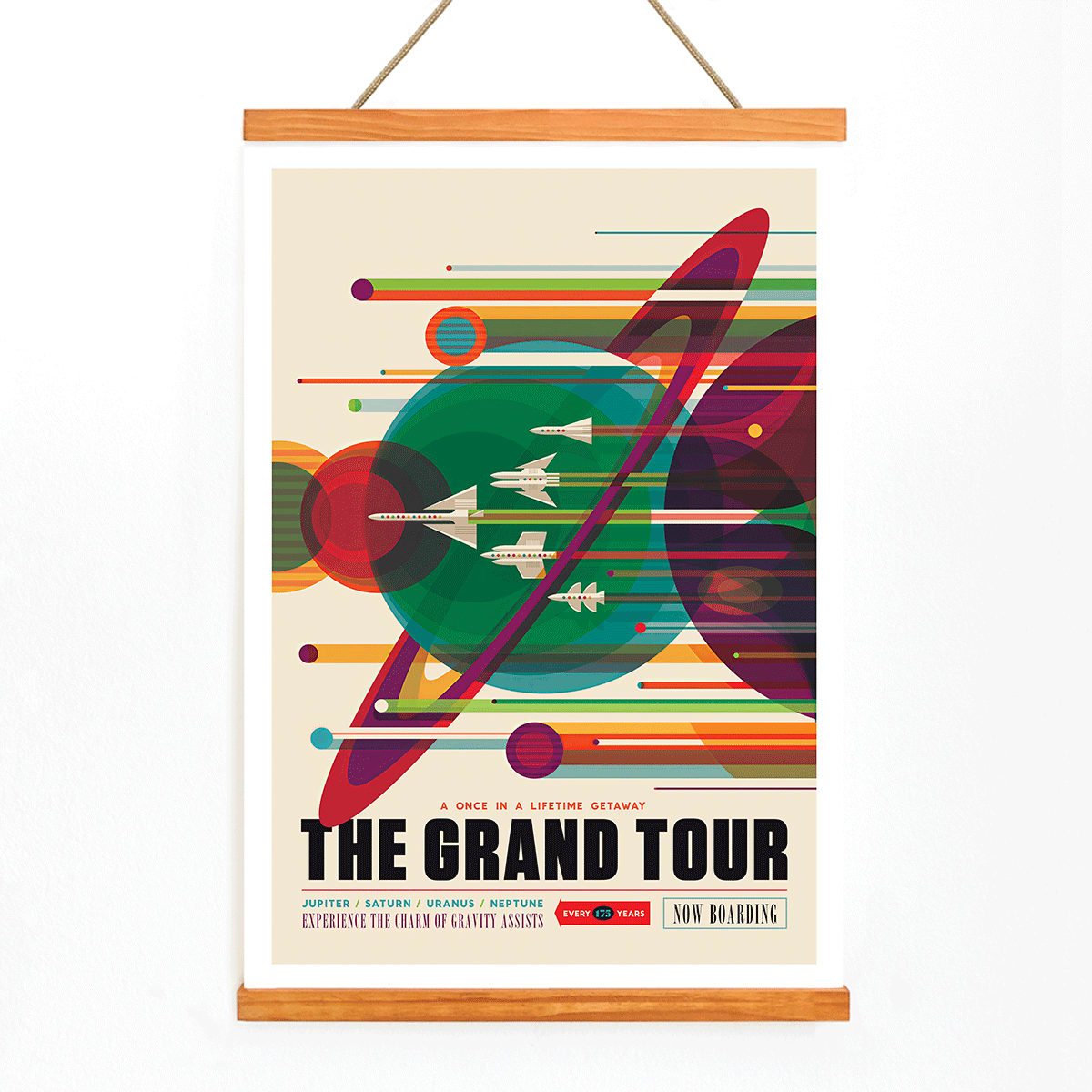
Karlyn Murphy is credited as the designer of The Grand Tour, created in 1977 during a period when space exploration captured the collective imagination. Her work reflects the late twentieth-century graphic design ethos, where clarity and optimism were central to translating scientific ambition into accessible visual culture.
Murphy’s approach draws inspiration from the educational and promotional materials of NASA’s golden era, blending technical accuracy with a sense of awe. Her designs helped bridge the gap between scientific communities and the public, making complex missions feel both approachable and inspiring.
The Artwork
The Grand Tour was conceived in the context of NASA’s ambitious plans to explore the outer planets using gravity assist maneuvers, a concept that defined 1970s space mission planning. This artwork embodies the spirit of discovery and the era’s fascination with the possibilities of interplanetary travel, reflecting how mission concepts were communicated to a wide audience.
As a visual homage to the original NASA Grand Tour concept, the poster captures the excitement of charting new paths through the solar system. It fits seamlessly with other space posters and visually engaging science wall art, making it a thoughtful addition to collections centered on exploration and innovation.
Style & Characteristics
The design features crisp, geometric shapes and sweeping lines that evoke the movement of spacecraft through space. Its palette includes green, red, yellow, beige, black, and purple, all hallmarks of 1970s print and educational graphics. The composition uses negative space and directional curves to create a sense of momentum and purpose.
The overall mood is forward-looking and optimistic, with bold planetary forms and clear trajectories that invite viewers to imagine the journey. The style is distinctly retro-futurist, making it both a nostalgic and visually dynamic piece for contemporary interiors.
In Interior Design
This poster serves as a striking focal point in home offices, studios, or living rooms where conversation and curiosity are encouraged. Its retro science theme complements mid-century modern furnishings, minimalist shelving, and industrial accents, especially when framed in black or warm wood.
For a harmonious look, pair it with beige walls, walnut finishes, or muted green tones, allowing the vivid colors to stand out. It also integrates well within horizontal posters and alongside warm neutrals from the beige collection.